


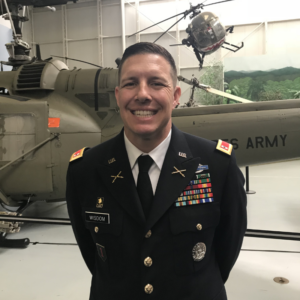
For 20 years , Paul Wisdom served his country—first in the United States Marine Corps , then in the United States Army. Service wasn’t just a career; it was the central thread of his identity. Every day, every mission, every sacrifice was driven by the belief that protecting others was the highest calling a person could answer.
Then, in a single instant, that calling was shattered.
An explosion—sudden, violent, life-altering—changed everything. Paul survived, but the impact rippled through every part of his life. Though he fought his way back to physical recovery, the real battle began afterward: picking up the pieces of a life that no longer looked like the one he had built over two decades.
Searching for Purpose After the Uniform
The military had been his world. Without it, Paul faced the overwhelming task of redefining who he was, what he could contribute and how to build a future that would support not just himself, but his family—and ultimately, humanity.
He took stock of his abilities, his passions and his limitations. He realized that to keep serving, to keep making a meaningful impact, he needed new technical skills , a new mission and a new direction.
Rebuilding Through Education
Paul enrolled at Houston Christian University (HCU) with the intention of becoming an engineer. Many people might see engineering as an intimidating path—but for someone returning to school after a twenty-year military career, working through injuries, academic gaps and a classroom full of students nearly two decades younger, the challenge was even greater.
But service had taught Paul something invaluable: discipline, resilience and the refusal to quit.
He pushed himself through pain, through doubt, through the difficulty of relearning how to study after years away. With accommodations in place, he fought through every test, every assignment, every late-night study session. And as the semesters passed, his confidence returned—not because the journey was easy, but because he would not give up on himself.
In the classroom, Paul didn’t just study engineering—he embraced it as the next chapter of his life’s mission. As his technical skills grew, his work began to stand out. He designed an autonomous sea-drone system, using artificial intelligence and GPS navigation to detect, collect and remove pollution from vulnerable waterways. His work attracted new industrial partners to the University, which ended up sponsoring the project.
Paul also played a pivotal role in strengthening his University’s engineering program. He redesigned the campus automation lab, developing new wiring schematics, writing updated control code and integrating modern hardware that had never existed there before. His contributions expanded the University’s capabilities and will provide hands-on learning opportunities for engineering students for years to come.
When Paul graduates, he will step into his next chapter as a mechatronics engineer , a rare and multidisciplinary field that bridges mechanical, electrical and computer engineering.
And through it all, Paul holds to the unwavering belief that the Lord guided him through every trial for a reason. He knows that the same God who carried him out of the blast will now use his skills, his perseverance and his renewed purpose to serve others in ways he could have never imagined.
HCU gave him an opportunity to connect with and serve veterans, Paul volunteered at the Veterans Services Center, because he understood the transformational growth that is possible, and helped to nurture that growth in others. Today he serves as one of the mentors in the VALOR program helping incoming students with their transition from military service to becoming successful students.