“However much we develop in numbers, academic programs and facilities, our calling is to provide an outstanding Christian education within the framework of a Biblical and Christian worldview, under the Lordship of Jesus Christ.”
From its founding, Houston Christian University has been a private, faith-based institution with an ambitious mission: to provide students with an education grounded in the Christian faith while preparing them to serve Houston, the nation and the world. In the early 2000s, the University stood at a historic crossroads, tasked with strengthening its academic and institutional roots while preserving its defining convictions. That moment of transition came in 2006 with the arrival of Dr. Robert B. Sloan Jr.
Two Decades of Leadership, an Enduring Mission
In July 2006, the Board of Trustees elected Sloan as Houston Baptist University’s third president on the unanimous recommendation of a search committee chaired by Diane Williams ’93. Sloan came to Houston after serving as chancellor and former president of Baylor University and assumed the presidency Sept. 1. He was inaugurated in November, with his wife, Sue Sloan, by his side.
What became a nearly 20-year presidency was marked by institutional growth, significant challenges, academic expansion and a sustained effort to define the University’s Christian mission for a new era.
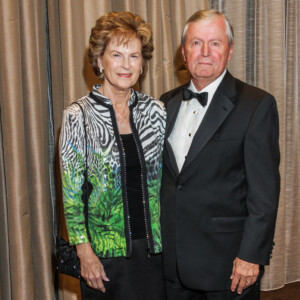
Robert Sloan was a great university president: attracting and motivating distinguished educators and students to enable so many productive lives! His strategic plans and execution elevated HCU and enriched its curriculum. He was a model citizen that displayed the best character traits worth emulating. It is essential for the faculty and students to have respected leadership. Robert and Sue had the biggest and best family imaginable. His children and grandchildren are their best contribution to humanity. After the trip to the Holy Land that he guided, Barbara and I can attest to his knowledge and personal relationship with God. We have faith that he is at peace in God’s Grace surrounded by his loved ones with the deep understanding that has been promised. He lived with faith, hope and love, and will always be remembered for a life of accomplishment and love! – Corby Robertson, Jr.
A Vision for the Future
In 2008, the Board adopted “Ten Pillars: Faith and Reason in a Great City,” a 12-year institutional vision designed to guide the University’s academic, spiritual and institutional development. In 2020, Sloan authored “The Ten Pillars 2030,” establishing core convictions to guide the University into the next decade.
The vision was accompanied by a transformation of the physical campus. The Joella and Stewart Morris Cultural Arts Center and Belin Chapel opened in 2007. The University Academic Center, Lawrence Park and Lake House Residence followed in 2008 as part of a $35 million development. The University Theater was named the Linda and Archie Dunham Theater.
Subsequent projects included Belin Tower, the Doris and Terry Looper Learning Commons and the Morris Family Center for Law & Liberty, which opened in 2022, with completion of Founders Hall II in 2025. The most recent project is the construction of the Sherry and Jim Smith Engineering, Science and Nursing Building, slated to open in Spring 2027.
Growth Through Challenge
The University’s transformation through the years, unfolded amid significant adversity. Hurricane Ike struck Houston in September 2008, causing an estimated $8 – $10 million in damage, with the M.D. Anderson Student Center and Brown Administrative Complex hardest hit. During the national financial crisis, the University was forced to reduce its budget by 6%.
Sloan’s administration also oversaw a major transition in intercollegiate athletics. HBU sued the NCAA over its retroactive seven-year probation policy, ultimately settling in 2009 with the probation period reduced to four years. Full NCAA Division I membership was restored in 2011. HBU joined the Southland Conference in 2013 and introduced football. By the end of Sloan’s presidency, NCAA Division I sports had increased from five in 2005-06 to 17.
Expanding the Academic Mission
Academic growth was equally significant. The Graduate School was established in 2009, followed by programs in biblical languages, philosophy, apologetics, counseling, management, entrepreneurship and executive educational leadership.
Houston Theological Seminary was founded in 2016, and the first doctoral program, an EdD in Executive Educational Leadership, launched that fall. The Pampell Online Division was launched in 2017, and the College of Engineering enrolled its inaugural class in 2018, with cyber engineering becoming the first such BS degree in Texas. The College of Science and Engineering was formed in 2019, and the Houston Cyber Education Center launched in 2021.
By fall 2026, under Sloan’s leadership, enrollment had reached a record 5,285 students, 147% higher than when Sloan began his presidency. Freshman enrollment had increased 132%. Degree programs grew from 54 in 2006 to 115, including 69 bachelor’s and 41 master’s programs, while doctoral programs increased from zero to five.
The University’s resources and residential capacity grew alongside enrollment. The endowment surpassed $100 million, endowed scholarships increased to 350, and nine endowed chairs and professorships were established. Residential capacity reached 1,052 beds before the 2025 repurchase of University Place added roughly 350 more, bringing capacity to approximately 1,400.
Dr. Diane Williams ’93, HCU Trustee
From the privilege of serving on the Presidential Search Committee, which brought Dr. Sloan to HCU in 2006, to the privilege of serving on the Board of Trustees during his leadership, I have been blessed! I have also been blessed by the special friendship that developed between Dr. Sloan and Sue and my husband Stanley and me. Dr. Sloan was a great example of Christ-like faith to all, while being full of fun and fellowship with special friends, among whom I have been blessed. –Dr. Diane Williams ’93
HOUSTON CHRISTIAN UNIVERSITY
The University’s transformation was reflected in its name. On May 17, 2022, the Board approved the change from Houston Baptist University to Houston Christian University, and the transition was announced Sept. 21.
The new name reflected an institution that had grown considerably in size and academic scope while continuing to emphasize its Christian identity. That same year, the University added the Doctor of Ministry as its fourth doctoral program.
THE END OF AN ERA
By 2026, the University Sloan inherited in 2006 had been transformed. Its campus had expanded, academic programs had multiplied, doctoral education had been established, Division I athletics had grown, enrollment had reached record levels and the University’s resources had increased significantly.
Sloan passed away suddenly on July 4, 2026, at age 77, just weeks before the 20th anniversary of his assuming office. On July 10, more than 1,200 friends, family and members of the HCU community gathered in Dunham Theater to pay tribute to his legacy. A thousand more viewers watched the services streamed live over the Internet, and 1,700 more have viewed the recording online.
His unexpected passing closed a defining chapter in the history of HCU, but his visionary leadership left a clear pathway forward for the University to follow.
That pathway was rooted in something Dr. Sloan repeatedly identified as more important than growth
itself: the University’s Christian identity and mission. At a May 19 dinner for current and former trustees, Dr. and Mrs. Sloan hosted members of the University community who had helped guide HCU through decades of change. In a fitting close to the evening, Sloan reflected on what he believed was the greatest responsibility facing those entrusted with its future.
“The greatest need I must lay in front of all of us, as a reminder and ongoing need, is the importance of maintaining our Christian identity and mission,” Sloan said. “However much we develop in numbers, academic programs and facilities, our calling is to provide an outstanding Christian education within the framework of a Biblical and Christian worldview, under the Lordship of Jesus Christ.”
He continued by emphasizing the importance of having trustees, faculty, administrators and staff who do more than simply tolerate the University’s Christian identity. Dr. Sloan made it his task to seek out people who “embrace it, support it and further it.”
“That’s the last word I’ll leave you. If we fail there, we have failed at everything. God bless all of you.”
Robert B. Sloan, my dad, served as President of HCU for nearly 20 years. Those who know well either Robert or the University are familiar with the phrase, “Jesus Christ is Lord.” This statement, of course, forms the nucleus of the preaching of apostles in the New Testament, and its gravity draws into its orbit the submission of all of creation to its claim.
On its foundation, Robert sought to lead Houston Christian University, and by its example, Christian higher education, into the pursuit of a learning subservient to Christ’s Lordship over all creation. No discipline, he believed, fell outside the realm of His dominion, and for this reason, all avenues – the material sciences, literature, philosophy and the Scriptures – could and ought to be studied in service to and in honor of the One through whom and for whom all things were made. This confession grounded the goals of the universities Robert sought to lead and the manner in which he led them. Under his leadership, with the help of faculty and staff energized by this common faith, Houston Christian University flourished.





Robert Sloan was a great university president: attracting and motivating distinguished educators and students to enable so many productive lives! His strategic plans and execution elevated HCU and enriched its curriculum. He was a model citizen that displayed the best character traits worth emulating. It is essential for the faculty and students to have respected leadership. Robert and Sue had the biggest and best family imaginable. His children and grandchildren are their best contribution to humanity. After the trip to the Holy Land that he guided, Barbara and I can attest to his knowledge and personal relationship with God. We have faith that he is at peace in God’s Grace surrounded by his loved ones with the deep understanding that has been promised. He lived with faith, hope and love, and will always be remembered for a life of accomplishment and love! – Corby Robertson, Jr.