


[By Mary Ann Harris and Laureen Mgrdichian, 2019]
How Christian marketers can make a difference for God in the challenging marketing communications industry
Abstract
Marketing departments and advertising agencies have a great impact on the Kingdom mandate, especially through their influence on Christian identity and cultural values. Yet, Christians may be timid to enter the profession or reluctant to find their voice in these environments, as their values vary from those of their peers and superiors. This essay uses an integrative approach to unpack how godly principles can be found in the marketing world, discuss the generations that are having the greatest influence on this profession, and suggest ways Christian marketers can impact change. Sharing from the authors’ practitioner and researcher backgrounds, it offers some helpful recommendations on how Christian employees can shape values in these environments.
INTRODUCTION
Christian marketers and academics would likely agree that advancing godly principles is important yet difficult work in the intensely aggressive and usually frenetic world of modern marketing and advertising.
As advertisers focus on their goal to gain consumer preference and loyalty, the work environments where they pursue these endeavors are rarely filled with Christian values. While this dilemma may not be new, it is likely even more prevalent as marketing techniques change rapidly and digital methods inspire fast response and a crowd mentality. In this paper, we propose a framework to help Christian marketers—and their managers—consider ways to advance biblical values in the midst of this fast- paced environment—one that is often fraught with ethical dilemmas.
While we are primarily addressing the boomer or Gen X manager of the Gen Y/Z marketer, we believe our ideas will
connect with a broad range of Christians. In this quest, our desire is to advance a discussion of how Christians who work in these environments can make a difference for God’s glory.
UNDERSTANDING THE MARKETING WORLD
Jesus used the power of the narrative in his teaching, listening to connect and understand the truth he was
conveying. Similarly, the use of the narrative in advertising today is to help connect with audiences at a deeper level
than methods used in the past. Unbeknownst to the viewer, narratives display a value system of what is important,
what is normal, and what is acceptable. According to Gulas and McKeage, given the excessive amounts of time that
people spend consuming media of all forms, ads impact people’s values, self-image, and expectations of those exposed to them.1 One can watch high-profile TV ads today to see the narrative model in action.
Often, the brand sponsor is very subtle, as the entertainment element is overt. While the message
hook can be based on humor, beauty, or fear, the set up for the approach is filled with cues about values
and norms in our society.
The type of people shown in the ad, the kind of music played, and the storyline all set the tone for what we see as “normal,” and the marketing services firm often sets this agenda. Lantos reminds us there is a healthy debate on whether advertisers mirror culture or are involved in the “mind bending” of society.2This industry segment is comprised of a variety of persuasion-based organizations such as ad agencies, PR firms, promotion houses, digital shops, and marketing services departments in corporations. According to Plunkett Research, advertising agencies and the marketing services industry are expected to reach almost $63 billion in revenue by 2025.3Moreover, it is a field that is dominated by the younger generation. In 2017, the majority, or 63 percent, of workers in advertising, public relations, and related services were under 45 years of age.4 Ad Age (a leading industry trade publication), attributes much of the bias toward younger workers to digital advancements that have transformed the industry over the last two decades.5 Both marketers and agencies are eager for tech-savvy youths who look the stereotypical part of creative hipster, hoodie and all. They are organizations filled with employees who are from the Gen Y generational cohort, with the younger generation of Gen Z close behind.
MILLENNIALS (GEN Y)
Rodriguez et al. discuss a study completed by EY (formerly Ernst and Young), which identified some characteristics of
the Gen Y workforce: although they are tech-savvy, they scored poorly not only as team players but also in descriptors
such as hardworking and being a productive member of the organization. This could be troublesome, as these
authors also identify that this cohort will make up 50% of the workforce by 2020.6 In addition, this
cohort lacks the loyalty exhibited by previous generations.7The authors cited a Deloitte 2016 study
that projected that “67 percent of young professionals planned to quit their current jobs by 2020 and more than 40 percent planned to quit in the next 2 years.”8 The expense of such turnover is estimated to be in the billions.9 This same Deloitte study describes this turnover as a loyalty challenge for Gen Y, as they place their personal values higher than the goals of an organization. As a result,they will either not work for companies that are unalignedwith their values, or they will have difficulty working for such companies.10
This values perspective is interesting to consider for the Christian marketer. Clearly, the Gen Y employee comes into the firm with their value system, which they feel committed to uphold. This can impact the Christian millennial who encounters a workplace culture that is contrary to their faith. How will their Christian values hold up when the environment is not necessarily sharing the same worldview?
POST MILLENNIALS (GEN Z)
In America, Gen Z is the most diverse of generational cohorts in both race and ethnicity.11 The oldest of this cohort were just beginning preschool when 9/11 occurred. They watched from the sidelines (as elementary children or toddlers) while their parents weathered the recession of 2008. They are called “digital natives,” as they have grown up in a land that has always had the Internet and knowledge at their fingertips. In addition, they have come of age in a culture that experiences mass shootings, bombings, and terrorism on a global scale. Aguas identifies the term “screenagers” (coined by Blakely in 2014) because of Gen Z’s ever-present exposure to the Internet and smartphones.12 Data from a 2018 Barna study, according to Esqueda, reminded us that this is the first cohort to grow up with parents who were also on their screens, unlike the parents of their Gen Y friends.13 According to Aguas, the leadership qualities that members of Gen Z pursue are those that are “honest, transparent, authentic, and genuine.”14 Gen Zs see great purpose and significance in their work life. They truly believe they can have an impact on the world and create real change. By the year 2020, they are expected to make up 20% of the workforce.15
More importantly, a Barna study conducted in 2018 identified that the Gen Z cohort has grown up in a culture
where Christianity has lost its major place in society. Esqueda discusses the worldview of Gen Z, based on the
Barna study, as one that is “inclusive, to all people, practices, and perspectives.”16
Although this allows them to love others and see them as Christ sees humanity, it could keep them from committing to a strong faith. Esqueda believes this could sift out all the lukewarm, “just-because-it’s-Sunday-believers,” and provide an opportunity for deeper, more committed Christians in this cohort. While these findings are clearly generalizations, they are important reminders that the Christian marketer who fits into this generational cohort will be fighting against a paradigm characterized by relativity and temperance that must be carefully considered as they live out their faith in the workplace.
FAITH IN AN AGE OF ETHICAL PLURALITY
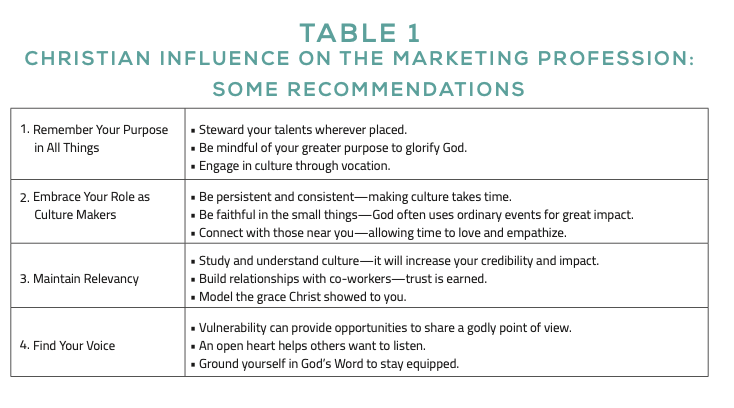
Sharing from the authors’ practitioner and researcher backgrounds, we offer the following suggestions on how a Christian marketing professional can shape values in these environments:
1. REMEMBER OUR PURPOSE IN ALL THINGS
A foundational question for the Christian marketer focuses on how they can hold their view of work in a way that is untainted by the world’s values. How we work has great significance. The apostle Paul is not partial toward those professions that glorify God. He states very clearly in 1 Corinthians 10:31, “So, whether you eat or drink, or whatever you do, do all to the glory of God.”17 Again, in his letter to the church at Colossae, he states, “Whatever you do, work heartily, as for the Lord and not for men” (Col. 3:23).
As believers, we are clearly called to honor God in all we do. This gives the marketer a simple focus—do your work to glorify God. What a tragedy if we discouraged Christians from entering industries just because they were more challenging for them in their faith-walk. We are called to steward the talents God has given us wherever He places us. Sayers shows the contrast between one who does their work for work’s sake and the one who has a greater purpose in their work. What happens is that those who have a greater purpose in their work would work with greater enthusiasm because of the outcome they feel they are contributing toward.18 This in itself should give Christians great enthusiasm in the work they are doing, if they are doing it for the glory of God.
Stevens, in his book Work Matters: Lessons from Scripture, reminds us of the value work plays in our lives. He shares five biblical principles regarding work that are drawn out of the first five books of the Bible:19
- Work is part of our God-imaging dignity;
- Work has been corrupted and degraded by human sin;
- Work is to be undertaken with integrity and justice;
- Work is limited by Sabbath;
- Work can be virtuous when undertaken with faith, hope, and love and is an expression of God’s call for all human beings.19
All too often, Christians hold on to point two in the list above and use it as an excuse not to engage in various aspects of society that, in reality, can be used to glorify God and benefit our culture. Grudem reminds us that “in every aspect of business there are multiple layers of opportunities to give glory to God, as well as multiple temptations to sin.”20 Christians can use their occupation to glorify God even if the industry doesn’t seem to be a God-honoring profession on the surface.
Part of the task for the Christian manager is to model Christlike behavior throughout their work experiences. We are called to display genuine care for others. Both the marketing function of promotion and the research that garnered the insights gives the marketer the ability to truly meet the needs of their customers. Philippians 2:4 exhortsus to watch out for the interests of others: “Let each of you look not only to his own interests, but also to the interests of others.”21 An excellent management philosophy can identify what the needs (interests) of others are and care for them in a way that is God-honoring, benefiting both the consumer and the company in the process.
Grimes and Bennett suggest Christ-centered leadership should focus on a powerful obligation to practice ethical, servant leadership: to serve, mentor, develop, and nurture their followers. The authors discuss a leadership style that embodies the approach of a servant as modeled by Jesus Christ in the New Testament and is accomplished through redefining who we are in relationship to God, versus a general philosophy geared toward being kind and helpful. They remind us of the many merits of servant leadership and discuss ways to practice these principles of engaging people.22Wrenn, Hoover, and Warwick have put together a scrip-tural basis for the discipline of marketing. The first concept they reviewed is that marketing is a way to “serve the needs of others.”23 As marketers strive to serve the needs of others, they will be living out part of what we are called to do as Christians. It will be a “challenge” for the marketer,24 but to keep our commitment to follow Christ’s teachings, we must rely on Christ and His strength when we are chal-lenged in our vocation.
2. EMBRACE OUR ROLE AS CULTURE MAKERS
Crouch challenges Christians to take on the task of being persistent when working with difficult cultures if ever we are to change them. He proposes that there are five actions Christians can take toward culture: condemn it, critique it, copy it, consume it, or create it. He identifies creating culture as the only way to truly change culture. As Christians, our mandate should be to create culture.25 Crouch proposes that “Culture is what we make of the world.”26 In addition, it is where we express our meaning: “We make sense of the world by making something of the world…Meaning and making go together—culture, you could say, is the activity of making meaning.”27
Crouch argues that “changing the world” is a magnificent and difficult task; especially when one considers how hard it is to bring about change in our own personal lives. He believes that we are made to change the world in “small scales and (occasionally, and probably not as often as we think, hope or expect) at large scales.”28 However, the trouble comes when we believe the “heedless rhetoric” to change the world and fall into the temptation of interpreting what this means, which then typically exposes us to pride as we set out to accomplish this noble task.29
If we are to listen to Crouch’s advice, we should find the modern marketing environment a wonderful place to pursue
this change. Much of the work in these organizations focus on finding ways to connect with audiences in “real”
and emotional ways and use stealth methods to persuade people. Stories are a very popular means of making these
connections, as they have been proven to connect with consumers in meaningful ways.30 In fact, we propose that in order to effectively create, one needs to connect. Without connection, the creative process can be arduous and off point. The concept of connecting through story is relevant to both the work environments of the creative process and the output of that process to consumers. In modern advertising, we see this at work in high-profile ads that often convey values through storyline, setting, character, and plot.
Values that are leveraged in these marketing messages are typically either values-neutral or challenge consumers
to expand boundaries and focus on self-gain. These ads can push for ideals that appeal to our base-level instincts—
such as the high-profile ads for automobile manufacturers (e.g., Matthew McConaughey for Cadillac) or alcohol brands (e.g., The Most Interesting Man in the World campaign for Dos Equis beer). Yet Romans 12:2 instructs us to “not be conformed to this world.”31 We typically see this mandate as an active choice on our end, aiming to be “transformed by the renewal” of our minds. However, neglecting to recognize the subtle effect that narrative stories can have on Christians is concerning even though the “conforming” isn’t overt.
A recent article by Fischer identifies the need to evaluate how marketing and social systems have a “reciprocal”
relationship, each impacting the other.32 Marketing practices do have an impact, yet the concern is how large an impact they may be having on society as a whole, not just on an individual consumer level. If indeed they are having an effect on society at large, this is all the more reason Christians should be using their talents in the marketing arena. The ability to shape culture is a task we must steward well. It is truly a gift to have such a platform in which to have influence in society. In fact, we are called to be lights, to not blend in with the culture, but to be the light society so desperately needs in this dark world. Matthew 5:14 reminds us, “You [We] are the light of the world. A city set on a hill cannot be hidden.”33
A Christian employed in the typical marketing firm has many opportunities to witness in these environments. For
example, humor is a creative technique that is regularly used in developing messages as a means of pleasantly surprising people and entertaining them. It is also a prevalent means of communicating in the hallways and team meetings. The lighthearted nature of the creative development workspace is an important place to influence. It is easy to gain favor at the expense of other people and in ways that perpetuate secular norms (applauding the worker out late at the bar the night before or making fun of the “poor guy/woman who has to go home to the family”). How important (and surprising) it would be to challenge the employees to get beyond the quick laugh and crowd mentality. Christian marketers can reinforce a more biblical set of values even if the word “Bible” is not
broadcast. Dramatic narratives are another means to capture attention quickly and permeate the culture. Drama is powerful, as it inspires both empathy and sympathy and offers long- term effects to brand sponsors.34 Escalas and Stern tested differences and connectedness between sympathy and empathy derived from the dramatic marketing message. They found that people who experience sympathy remain emotionally conscious of their personal lives and understand, but do not directly experience, another’s feelings; whereas, people who experience empathy completely forget their own personal existence by sharing the feelings of the character.35 Empathy is the emotion on the rise in developing messages, and one can appreciate its power to influence audiences.Displaying empathy to co-workers is a practical way we show Christ’s love to others.
There are many moral nuances present when conducting the work of developing campaigns. Whether an employee
is an artist, copywriter, or strategist, many valuable discussions and trade-offs play out in the agency conference
room. Environments like these are very team-oriented,with brainstorm sessions and small group meetings as the
norm. Equipping the Christian marketer to develop moral sensitivity is important in both personal as well as project-
oriented situations. Peer to peer, employees may witness fellow employees having struggles at home and could use a
friend and confidant. At work, they may hear office gossip or disparaging remarks about clients or management. Dominant ideologies get passed along without even realizing it as time pressures and market demands are pursued. Promoting shalom in the context of these emotional discussions is not only practical but relevant.
3. MAINTAIN RELEVANCY
Hagenbuch reminds us that in order for marketing to be most effective, it must be “mutually beneficial” to the buyer and the seller.36 After all, if a company isn’t profitable, their business will not be sustainable for the future, which then affects the livelihood of their employees. He states that “marketing practiced with integrity holds uniquely great potential for serving all stakeholders: consumers, marketers, and society.”37 It is by serving all the stakeholders that a company can stay relevant in the marketplace. Hagenbuch went on to remind us that marketing is not a zero-sum game. There can be winners on both sides of the buyer/seller relationship. He outlined how value is derived from each of the four P’s of marketing (product, place, price, and promotion) and wisely observed that the value derived from the fourth “P” (promotion) is the hardest to qualify. He discussed the view that “Marketing communication [promotion] does hold value for both parties; however, that value is secondary to the other elements of the exchange. If there’s no potential value in product, price, and place, there’s really no point in communicating [promoting].”38
Yet this goal Hagenbuch defines goes beyond the end-user of the product. It is a very relevant challenge to the Christian marketer, too. If we are to be seen as useful in a culture-shaping industry like marketing, then we must be part of that culture. We must add value in these environments and actively participate. Separating ourselves from the culture is not the way to win fans and influence employees. And if the employees we are influencing are questioning their faith, then one of our goals as their Christian managers is to influence their ideals in a respectful, authentic way. Connecting is key to being relevant to those around us. Maxwell states that “Connecting is the ability to identify with people and relate to them in a way that increases your influence with them.”39 Maxwell projected that 80 to 90 percent of the connecting we do is done on a one-on-one level.40 Yet even in a group setting, it begins with the individuals in the group.
Cloud identifies the ability to “connect authentically” as a part of one’s character that has a direct impact on one’s
effectiveness.41Specifically, qualities of empathy and validation are necessary in this quest for connection.42
According to Cloud, connection is necessary to build trust.43 Trust is a necessary ingredient if one is to have influence
and relevance in the lives of others. As well, Cloud discusses another element of building trust as watching out for others (being “for, not against”), showing them grace (or “unmerited favor”) and unmerited help.44
These same principles of building trust are reflected by Hagenbuch. He suggests two overriding principles for
marketers selling to consumers that are relevant to marketers managing younger employees:45 Influence others to their benefit, and love your neighbor as yourself (Luke 10:27). Developing the ability to influence others to their benefit requires connection. Maxwell reminds us that the ability to influence is tied to how we connect with others.46 However, connecting is more than just words we use. He identifies four levels of connectedness needed in order to lead well: visually, intellectually, emotionally, and verbally.47
How can we shine if we are not in the world to connect with those around us? Jesus teaches us in John 17:14-16, “I have given them your word, and the world has hated them because they are not of the world, just as I am not of the world. I do not ask that you take them out of the world [identifying that they are, indeed, in the world], but that you keep them from the evil one. They are not of the world, just as I am not of the world.”48 Many Christians consider the “in” and the “of” synonymous when it comes to their vocation. Consequently, this could lead Christians toward staying away from vocations that may seem more “in” the world. Choosing to stay away from a vocation such as marketing leaves a void of light in the marketplace. Loving and connecting with others takes being with them. We desire to spend time and connect with those we love.
4. FIND YOUR VOICE
As already mentioned, encouraging the Christian marketer to speak out when values are being discussed is important, as they play a role in shaping not only non-believer’s views of Christians but consumers’ views as well. The challenge is for both the younger Christian marketers and their managers to pick their battles and take a stand to challenge the status quo.
Cafferty suggests that vulnerability is key in the marketplace, whether we are talking about employees with employers, consumers with companies, or companies with customers. In Cafferty’s view, the purpose of business must be to foster the restoration of God’s image in humans, not in church but in a particular place where some parties are economically vulnerable to others. In the context of vulnerability, we as Christians have opportunities to demonstrate sacredness in the marketplace. It isn’t in the separateness of the market but, rather, in its integration where we can truly show our Christian principles.49 This vulnerability is readily present in a marketing services firm where long hours and regular debate on idea generation and creative techniques can provide the perfect environment to share a godly point of view.
Social impact theory proposes that the amount of influence a person experiences in group settings depends on the
strength, immediacy, and number of people in the group exerting social influence.50 Thus, a group that has many members (vs. a few members), high power (vs. low power), and close proximity (vs. distant proximity) should exert the most influence on an individual.51 Conversely, if the strength of the person exposed to the social influence (i.e., the target) increases, the immediacy of the group decreases; or if the number of targets increases, the amount of influence exerted by the group on the individual decreases. The theory has direct applications to persuasion and obedience.52 When working in an ad agency or marketing firm, the employee will often find the hours long and the time with peers significant. The influence of the group is strong and immediate, as much time is spent advancing work projects as well as building social relationships through sharing movies, recreational activities, or other forms of entertainment. Marketing is a very social profession. It is a challenge to determine how to take the high ground in
the industry, yet not get pulled into the everyday mindset of the mass of employees. Christian employees, especially
younger Christian employees, aren’t sure how to witness to others, so they may walk away. The apostle Paul has an
interesting discussion on this subject. He discusses how he acted like a Jew with Jews, and as if under the law with
those under the law.53 He connected with those around him. His style of speaking and manner of interacting was not the issue. The issue was to have an open heart and line of communication with people so they will take notice and listen to the good news you have to share. There are many people in these environments who need to hear this news.
CONCLUSION
Christian marketers today have the same challenges to consider as their non-Christian peers. They must find the right customers, engage their interest, and encourage them to buy—or buy into—their ideas and product promises. They must be clever and creative and work tirelessly to advance the mission of the workplace they chose to enter. Yet they have another mission to advance. They must find relevant and appropriate ways to share their faith and advance their eternal mission. They must try to influence mainstream culture instead of avoiding the tough conversations. In this essay, we have suggested a few ways to help Christians focus on such missions (see Table 1). As the marketplace continues to accelerate at breakneck speeds, Christian marketers must find the strength and wisdom to share their views and show the world (and their peers) how Christians remain relevant in a complex world. They must be reminded of Jesus’ persuasion tactics and find ways to leverage them in their own stories both inside and outside the workplace. Marketing isn’t going away any time soon. If anything, it’s becoming more influential. May Christian marketers find the wisdom and creativity to keep advancing the kingdom mandate daily.
Notes
1 John Kim, Mukesh Bhargava, and Sridhar Ramaswami, “Advertising Productivity: Developing an Agenda for Research,” International Journal of Advertising (20(4), 2001): 431-54.
2 Geoffrey P. Lantos, “Advertising: Looking Glass or Molder of the Masses,” Journal of Public Policy & Marketing (6(1), 1987): 104-128.
3 “Advertising Agencies and Marketing Services Revenues Market Size Forecasts Benchmarks Analysis (NAIC 541810),” Plunkett’s Market Research & Benchmarks Report (November 25, 2018), accessed June 11, 2019, http://www.plunkettresearch.com/industries/advertising-agencies-and-marketing-services-revenues-market-size-forecasts-benchmarks-analysis/.
4 Adrianne Pasquarelli, “Advertising Has An Ageism Problem,” Ad Age (November 18, 2019), https://adage.com/article/agencies/advertising-aegism-problem/315645.
5 Ibid.
6 Michael Rodriguez et al., “Managing the Next Generation of Sales, Gen Z/Millennial Cusp: An Exploration of Grit, Entrepreneurship, and Loyalty,” Journal of Business-to-Business Marketing (26(1), 2019): 43.
7 Ibid, 44.
8 Deloitte, “The 2016 Deloitte Millennial Survey: Winning Over the Next Generation of Leaders,”: 45. Accessed June 11, 2019, https:// www2.deloitte.com/content/dam/Deloitte/global/Documents/About-Deloitte/gx-millenial-survey-2016-exec-summary.pdf.
9 Ibid, 45.
10 Ibid.
11 Richard Fry and Kim Parker, “A Demographic Portrait of Today’s 6-21-Year Olds, From the Pew Research Center,” Phi Delta Kappan (100(7), 2019): 13.
12 Jake Aguas, “The Rise of Generation Z,” Paper presentation at Christian Business Faculty Association Conference, October, 2018, in Chattanooga, TN.
13 Octavio Esqueda, “What Every Church Needs to Know About Generation Z,” Talbot Magazine (November 14, 2018),2.
14 Aguas, 18.
15 Ibid, 16.
16 Escueda, 3.
17 1 Cor. 10:31.
18 Dorothy L. Sayers, “Vocation in Work” in Callings: Twenty Centuries of Christian Wisdom on Vocation, ed. William C. Placher (Grand Rapids: William B. Eerdmans Publishing Company, 2005), 412.
19 R. Paul Stevens, Work Matters: Lessons from Scripture, (Grand Rapids:William B. Eerdmans Publishing Company, 2012), 47.
20 Wayne Grudem, Business for the Glory of God (Wheaton: Crossway Books, 2003), 17.
21 Phil. 2:4 ESV.
22 Mark A. Grimes and Robert H. Bennett III, “Christ-Centered Leadership: God-Honoring Leadership for Committed Christians,” Journal of Biblical Integration in Business (20(1), 2017): 24-35.
23 Bruce Wrenn, Harwood Hoover, Jr., and Jacquelyn Warwick, Scriptural Foundations for Marketing (Berrien Springs: Andrews University Press,2013), 6.
24 Ibid, 8.
25 Andy Crouch, Culture Making: Recovering Our Creative Calling (Downers Grove: IVP, 2008).
26 Ibid, 23.
27Ibid, 24.
28 Ibid, 200.
29Ibid, 201.
30 Jennifer Edson Escalas, “Imagine Yourself in the Product: Mental Simulation, Narrative Transportation, and Persuasion,” Journal of Consumer Research (29(4), 2003): 566-78.
31 Rom. 12:2.
32Eileen Fischer, “If Not Now, When? The Timeliness of Developing a Dialogue between Consumer Culture Theoretic and Macromarketing Perspectives,” Journal of Macromarketing (39(1), 2019): 103.
33 Matt. 5:14.
34 Jennifer Edson Escalas and Barbara B. Stern, “Sympathy and Empathy: Emotional Responses to Advertising Dramas,” Journal of Consumer Research (29(4), 2003): 566-78.
35 Ibid, 566-78.
36David Hagenbuch, Honorable Influence, (Glendora: Aldersgate Press,
2016), 14.
37 Ibid, 11.
38 Ibid, 16.
39 John Maxwell, Everyone Communicates Few Connect (Nashville:
Nelson Books, 2010), 3.
40 Ibid, 20.
41 Henry Cloud, Integrity (New York: HarperCollins Publishers, 2006),
34-35.
42 Ibid, 58-68.
43 Ibid, 45-73.
44 Ibid, 80-86.
45 David Hagenbuch, Honorable Influence, (Glendora: Aldersgate Press, 2016), 161.
46 John Maxwell, Everyone Communicates, Few Connect (Nashville:
Nelson Books, 2010), 3.
47 Ibid, 53.
48 John 17:14-16.
49 Michael E. Cafferty, “The Sacredness of the Marketplace,” Journal of Biblical Integration in Business (20(1), 2017): 5-7.
50 Stevie Watson, Cassandra D. Wells, and Elania Jemison Hudson, “The Effects of Idealized Advertising Imagery on Social Comparisons, Psychological and Emotional Outcomes, and Consumer Vulnerability: A Conceptual Model,” Journal of Promotion Management (17(4), 2011): 407-17.
51 Ibid, 407-17.
52 Ibid, 407-17.
531 Corinthians 9:19-23.
About the Authors

Mary Ann Harris is an Associate Professor of Business and Economics at Bethel University in St. Paul, MN. Dr. Harris teaches in the marketing discipline. She has an MBA from Washington University in St. Louis and a PhD in Strategic Marketing Communication from the University of Minnesota. She has a deep background in marketing and advertising, having worked in large agencies in Chicago and Minneapolis and helped leading brand marketing efforts for Energizer Battery as well as Boston Scientific Medical Products. She has consulted with a variety of small and large businesses in marketing strategy and integrated marketing communications, with a particular interest in how brands impact values and culture. She and her husband John have three children.
 Laureen Mgrdichian is an Associate Professor at the Crowell School of Business at Biola University. She teaches courses in marketing, entrepreneurship, and women in leadership. Besides an entrepreneurial background, her corporate work includes working for Universal Studios in the promotion and planning of video releases, and in developing strong retailer relationships. She has managed and coordinated marketing promotions for grocery and mass merchandise-retail clients nationwide. Laureen received her MBA from the Anderson Graduate School of Management at UCLA, focusing on marketing and organizational development. She and her husband are the parents of triplets who are currently college seniors.