


Christian Business Leaders Take Their Faith Seriously
[By Ernest P. Liang, Glenn Smith]
The State of Faith Integration in the Marketplace
There is a common perception that among businesspeople who are professed Christians, the concept and practice of faith integration is foreign to them. John Knapp, in his book, Why the Church Fails Business People, described the disconnection between the clergy and the Christian workers in the business world.1 He points out that these Christians are not getting guidance to face their daily work challenges, not to mention being a Christian influence at work. As a result, Christians live divided lives between the church and the business world.
Christian academics often opined that the Sunday-Monday or Sacred-Secular divide is real and broadly accepted and practiced. Phillips and Phillips, for instance, suggest that:
First, Christians generally do not integrate their faith in their work. Second, many of them experience some distress because they do not. Third, both companies and employees might benefit if faith were more commonly integrated into their mutual efforts. And finally, even Christian business leaders struggle to identify concrete actions to achieve this integration. If Christianity is to be a way of life rather than simply platitudes and pronouncements, Christian businesspeople must examine how their faith informs their professional words, actions, decisions, and goals.2
It appears, especially amongst the general working population (as compared to influencers with leadership responsibilities), that a lack of an understanding of the theological imperatives and the practical know-how in implementing faith-integration in real life often resulted in frustration or confusion amongst believers. In a Barna Group study in 2018 of 1,450 Christian respondents, only 26% can clearly see how the work that they are doing is serving God or a higher purpose.3 On top of that, the same study found that only 28% of the Christian workers can be labeled faith-integrators, that is, those who can clearly see how the work they are doing is serving God or they can find purpose and meaning in the work they do.4 These statistics in fact tracks closely with the general population as a whole. For example, a 2025 Gallup survey of 4,475 U.S. working adults found that only 25% have a strong sense of purpose in their work and only 18% say their current job has a purpose they personally believe in, while 45% say they work primarily for a paycheck and benefits.5 So much about a purpose-driven or mission-driven life in a business career.
The Scripture is pretty clear about the nature of work – that it is a form of worship. The Hebrew word “avodah” (ah-vod-ah) is translated in the English Bible for both work and worship. Work is a form of service that God receives as worship done unto Him. According to the Puritans, the meaning of work is not to gain wealth or to satisfy selfish ambitions or even to make a living for one’s family. The appropriate rewards of work were spiritual and moral: work was to glorify God and benefit society.6 Theologians, such as Sherman and Hendricks,7 Novak8 and Stevens,9 among others, defended the intrinsic value of work and confronted the so-called “sacred-secular dichotomy” as it pertains to work, ministry and business. According to these theologians, to the extent that our “secular” work and our businesses contribute to the common good, our work is “missional” and “sacred,” and pleasing to God.10
Although empirical evidence appears to suggest the prevalence of the so-called Monday-Sunday divide, sincere Christ followers could mature into faith-integrators as they gain knowledge through humility during trials (James 1:2-4), discipline (Prov. 12:1), intentional living (Ps. 90:12), resilience (Prov. 24:16), and an awareness of personal responsibility (Gal. 6:4) that are enabled by the Holy Spirit. The opportunity for spiritual growth is particularly robust in the workplace. As theologian Guy Morrill observed,
It is in the handling of things that we have our largest, is it an exaggeration to say our only, opportunity to develop our moral nature. In ordaining this great system of business God gives us the means to be true and just, honest and faithful toward Himself and toward one another. Without the handling and disposal of things in business relations there could be no development of the Christian virtues of truth, goodwill, integrity, justice, goodness, generosity, faithfulness and the other traits of character… the business man if he would seek the Kingdom of God must seek and find it in the world of business.11
For faith-driven Christian businesspeople, the marketplace is but a big incubator for spiritual maturity. In their process of lifelong learning, it is highly possible that as they gain leadership responsibilities, they would exhibit emerging traits of faith integration even if they had not. The implication of this possibility is evident: purposeful integration of Scriptural instruction into university and vocational training curricula as well as in peer-to-peer learning environments (forums such as C12, Convene, Accord, etc.) can bring more businesspeople into the practice of faith-integration at an earlier stage of their professional career. Mentoring and the subsequent networking effect of this development could totally transform how business is done in the Kingdom of God.
In the summer and early Fall of 2025, the Center for Christianity in Business at Houston Christian University commissioned a nationwide survey of business leaders to gauge the current state of faith-integration in the United States. In this article we summarize some of the most important findings of this study, which to a not insignificant degree offers an interesting contrast with what was earlier reported by studies such as Barna’s (and speculation by Christian academics) on faith integration in the workplace. The important parameter in the contrast is the level of leadership experience of the respondents, as the current study focuses primarily on influencers with significant leadership responsibilities.
The observations below offer a commentary on the beliefs, desires (wants), and action focus of the studied faith-driven business leaders. Moreover, two themes of interest with implications for church and social policy emerged from the survey’s findings and are highlighted: Business as Mission (BAM) and the Protestant Work Ethics (PWE). Finally, the Appendix provides a summary of the methodology and demographic/faith characteristics of the study sample.
What Christian Business Leaders Believe
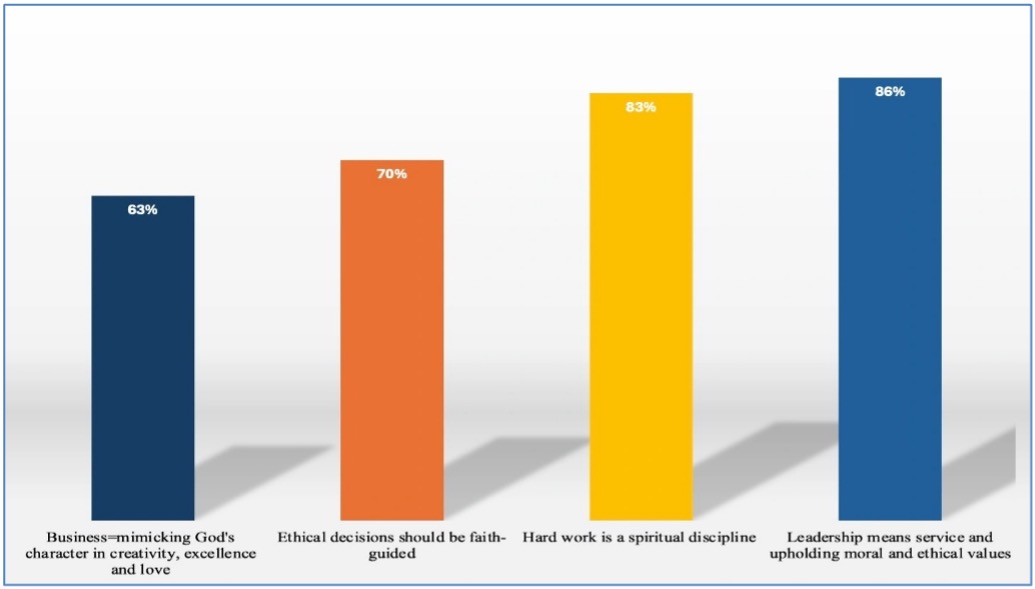
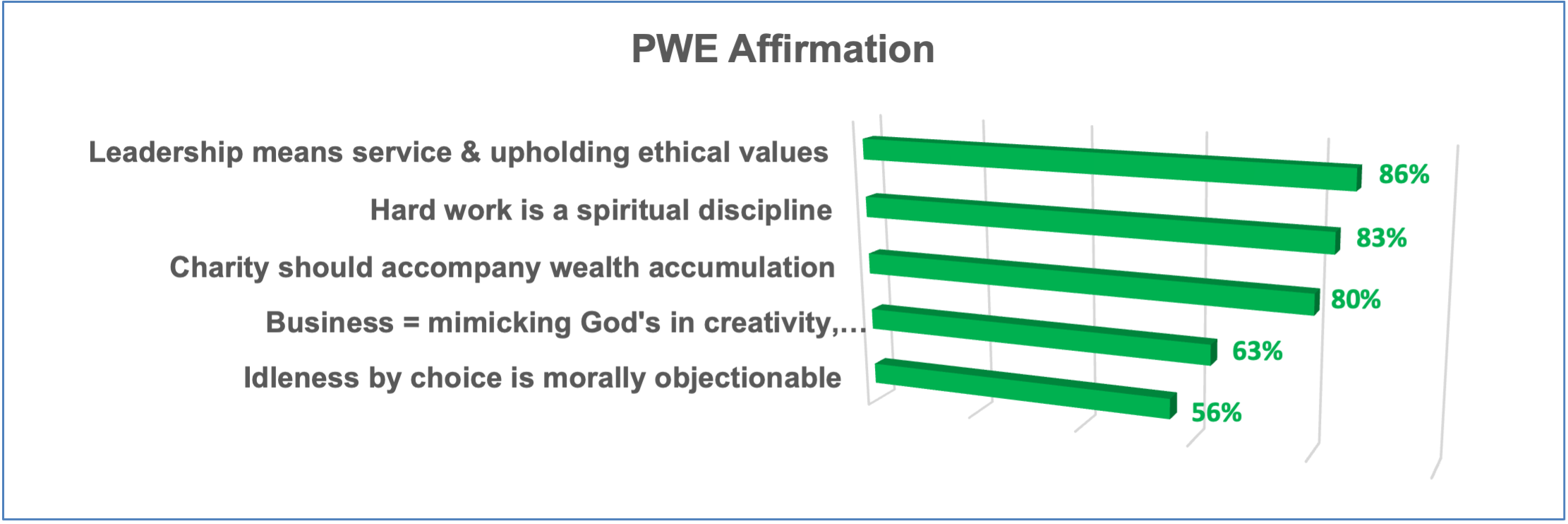
One of the most striking discoveries from the survey was that the overwhelming majority of Christian business leaders are purpose-driven and see business as part of their spiritual assignment. It was very clear that these business leaders viewed their businesses as a calling, not just a vehicle for income. Sixty-three percent (63%) of the Christian business leaders stated that their businesses should reflect God’s character in creativity, excellence, and love (Fig. 1). The majority went on to state that the purpose of their business was to fulfill a sense of calling or higher purpose inspired by faith, beliefs, or guiding values. Eighty-three percent (83%) said that to them hard work was a spiritual discipline.
In his book, Business as Mission, author Michael Baer talks about the seamless integration of business and mission. He states that “To pursue this seamless integration, we must reject the unbiblical thinking that our lives can be compartmentalized into the sacred and secular or that business and ministry are by definition separate activities. Scripture teaches us rather to embrace the truth that all Christ’s servants have callings that are high and holy and equally pleasing to the Lord.”12 This integration was clearly evident among the Christian business leaders surveyed.
A prominent way that this integration was observed was in the values and ethics of these business leaders. Not only did they connect their work ethic to their spiritual life, but eighty-six percent (86%) stated that business leadership is about service and upholding moral and ethical values (Fig. 1). Seventy percent (70%) emphasized that making ethical decisions according to their faith was imperative. The majority acknowledged that when culture conflicts with their Christian values they were intent on standing firm. These Christian-led companies are clearly shaped by a worldview where ethical consistency, diligence, and excellence are non- negotiable.
Figure 1
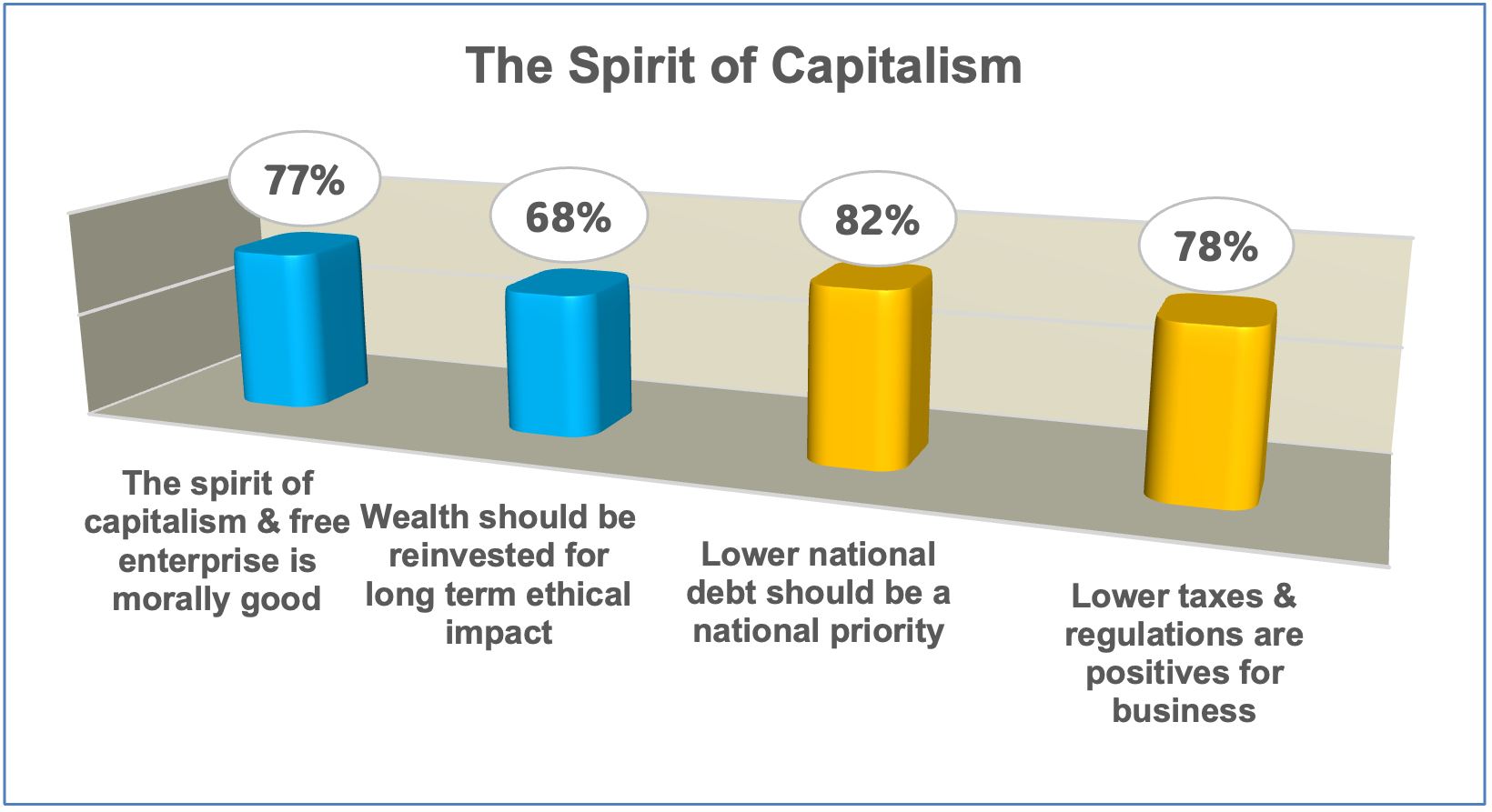
The Christian ethic was explicit in that these leaders overwhelmingly connected business to the “common good.” The belief that these business leaders were stewards of God’s blessings was evident in that the majority prioritized the common good, service, and servant leadership. Sixty-eight percent (68%) believed that wealth should be reinvested for long-term ethical impact (Fig. 2). These Christian business leaders see themselves not merely as profit creators but as community stewards with responsibility for societal flourishing.
Figure 2
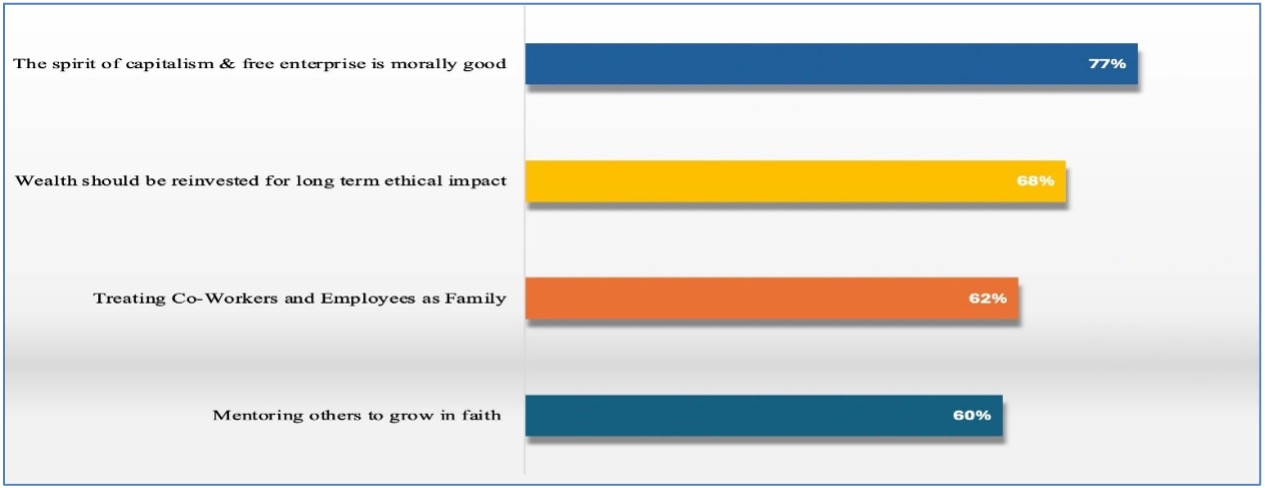
One of the most powerful ways that these owners integrated their faith was in their relationships. Sixty-two percent (62%) of those surveyed expressed the importance of treating co-workers and employees as family. A strong majority related success to having a positive impact on stakeholders, serving the community, and offering innovative solutions to society’s needs. They also stressed the importance of company policies that would enable a proper work-life balance. Sixty percent (60%) said that mentoring others in faith is central to their business life. These business leaders were intentional about integrating faith into their hiring, talent development, and their strategic priorities.
It is interesting to note that Christian business leaders hold a positive moral view of capitalism and free enterprise. Seventy-seven percent (77%) said that free enterprise is morally good. Christian leaders generally support capitalism, entrepreneurship, and limited regulation, seeing these systems as compatible with biblical values when practiced ethically.
This aligns with the perspective expressed by theologian Wayne Grudem in his book, Business for the Glory of God. Grudem argues that the various aspects and disciplines of commerce and business are not inherently evil. Nor are they morally neutral. He contends that they are actually morally good. However, he also acknowledges that they can be tainted by sin such as dishonestly, greed, etc.
Grudem believes that the components of business provide unique opportunities for glorifying God. He states, “We will find that in every aspect of business there are multiple layers of opportunities to give glory to God, as well as multiple temptations to sin.”13
From the research at hand, we see that Christian business leaders are aligned around a historically rooted, biblically grounded model of work – one that emphasizes discipline, service, generosity, Christian charity, and moral clarity.
Now that we have gained some insight into the beliefs and values of Christian business leaders, let us turn our attention to what these Christian leaders want as they pursue their vision and calling.
What Christian Business Leaders Want
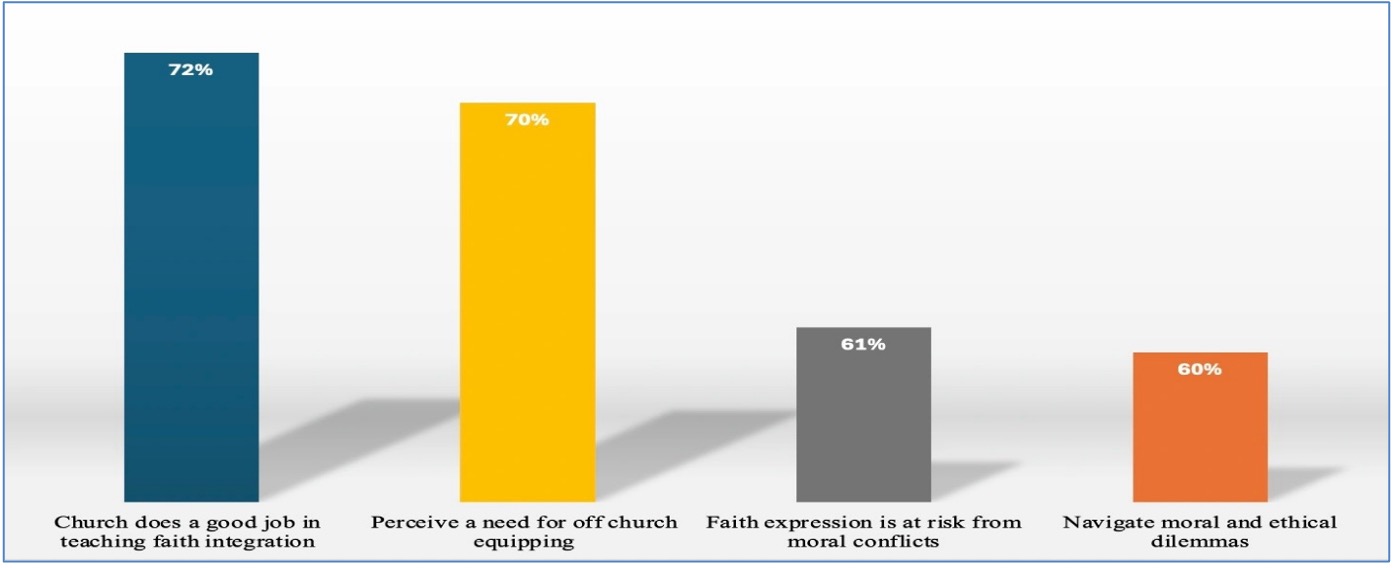
Across multiple questions in this survey, business leaders acknowledge significant difficulty navigating cultural shifts, ethical challenges, and faith expression in today’s workplace. Christian business leaders feel the tension of leading faithfully in secular environments and want more resources to navigate morally gray areas. These owners are also hungry for spiritual mentoring on work-life balance and healthier rhythms in their personal lives. The research revealed that sixty-one percent (61%) of Christian leaders feel that their faith expression is at risk from moral conflicts (Fig. 3). Sixty percent (60%) indicated that they were challenged by moral and ethical dilemmas. And while seventy-two percent (72%) believe that their church does a good job in teaching faith integration, seventy percent (70%) expressed a need for additional “off-church” equipping.
Figure 3
Darren Shearer, in his book The Christ-Centered Company, opined that a culture war is waging in the world today, and for-profit companies are at the center of it.14 The responses in this research support that perspective. Shearer goes on to state that, considering more than eighty-five percent (85%) of working-age people spend around sixty-five percent (65%) of their waking hours working in a for-profit company, it’s clear that the marketplace is the central battleground for competing narratives and ideologies that seek to steer a culture in a particular direction.15
The Christian business leaders in this survey clearly feel the responsibility and calling to be salt and light in a dark world. They are convinced that how they lead their companies has eternal significance, but the challenge is often intense. They want more resources and guidance as they seek to live out their calling in the marketplace.
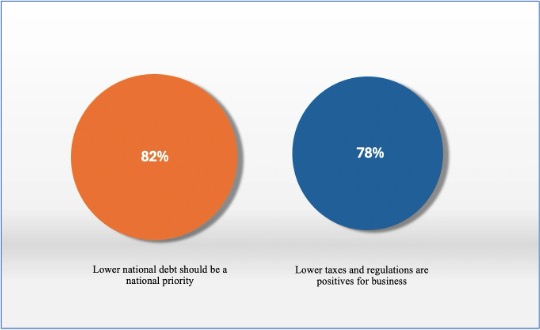
Another desire of Christian business leaders was related to public policy. The majority stated that current laws and regulations posed a challenge to their businesses and their mission. Seventy-eight percent (78%) indicated that lower taxes and less regulation would clearly benefit business, and eighty-two percent (82%) support lower national debt as a moral and economic priority (Fig. 4). Additionally, the majority also indicated that they desired policies that supported religious freedom and faith expression in the workplace. Christian business leaders want an environment where expressing biblical values is protected, not penalized.
Overall, the survey data paints a clear picture that Christian business leaders view their businesses as a spiritual calling, and they let their faith shape their ethical framework as well as their business practices. The data also shows that Christian business leaders desire stronger spiritual formation and peer support, as well as public policy to protect religious liberty. So, what can these business leaders do to help themselves?
FIgure 4
What Christian Business Leaders Can Do
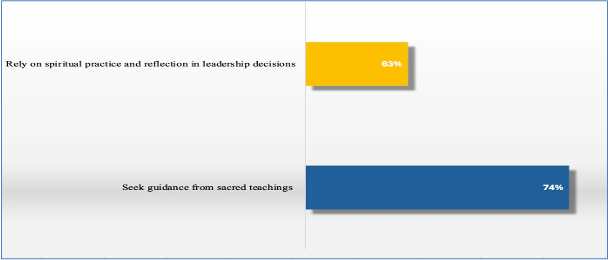
The research indicated that seventy-four percent (74%) of these business leaders relied on spiritual practice and reflection when making leadership decisions (Fig. 5). Sixty-three percent (63%) stated that they specifically seek guidance from God’s Word as they lead their companies. That said, one obvious action that Christian business leaders can take is to consistently and systematically study the Bible. This is the believer’s source for truth and wisdom. When facing the trials and challenges of business leadership, God gives specific instruction stating, “If any of you lacks wisdom, let him ask God, who gives generously to all without reproach, and it will be given him” (James 1:5 ESV.)
Figure 5
Christian business owners would find an excellent online source of training in faith-integration in the HCU Center for Christianity in Business’ “The Habits of a Christ- Centered Company” curriculum. Other helpful sources include Business for the Glory of God by Dr. Wayne Grudem, and Business as Mission by Michael Baer, just to name a few. Many find Christian podcasts such as “The Christian Business Leader Podcast,” which impacts faith-driven business leaders in over 160 countries, to be very helpful.
Given that business leaders express desire for off-church learning and training opportunities, ministries such as those offered by the HCU Center for Christianity in Business that specifically aimed to equip and educate business influencers to be mission focused leaders would be particularly helpful. Another excellent resource for Christian business leaders is national peer advisory groups such as C-12, Convene, and Accord (a new, partner peer-learning ministry of the Center which is designed to appeal to business influencers at all levels of leadership responsibility.)
Business as Mission (BAM) – Some Missing Links
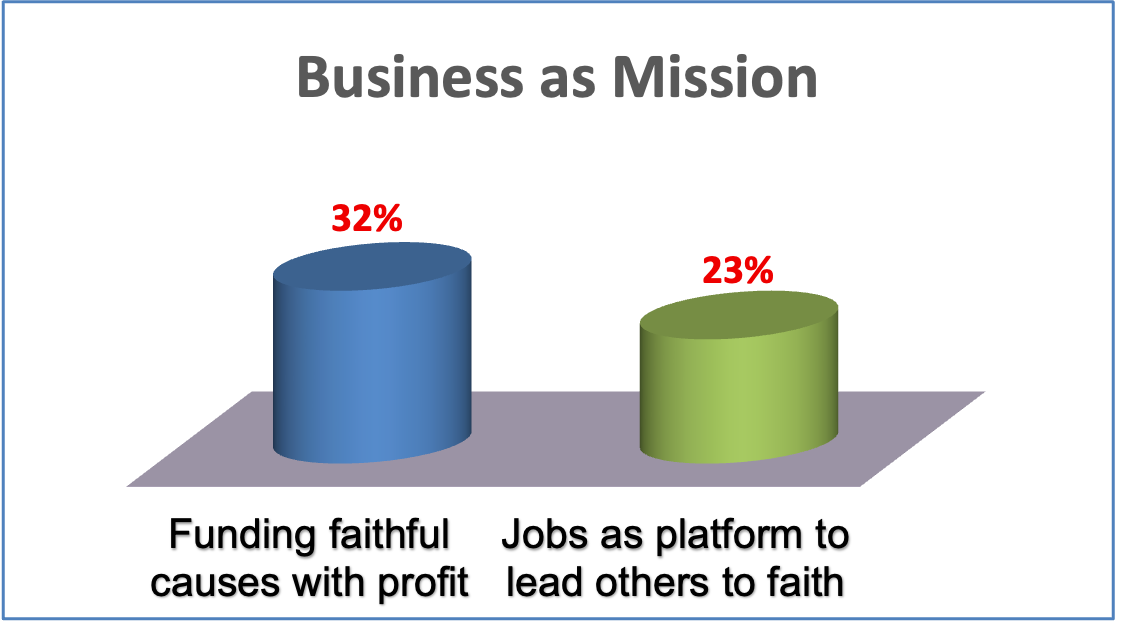
While the study demonstrated that an overwhelming majority of the respondents embrace ethics and morals, care and compassion, and courage and perseverance as key value drivers, a surprisingly weak response was registered in the intention of using the workplace as a platform for mission-centric faith sharing and ministry financial support. Notably only thirty-two percent (32%) of the Christian leaders agreed that profit should be used to fund faithful causes and twenty-three percent (23%) would consider jobs to be useful platforms to lead others to faith (Fig. 6).
Figure 6
C. Neal Johnson, in his book Business as Mission, defined the term as:
A for-profit business venture that is Christian led, intentionally devoted to being used as an instrument of God’s mission (missio Dei) to the world…First, they minister to all those who are directly in the business’ spheres of influence, such as their workforce and their families, suppliers and vendors, investors and creditors, customers and clients, even competitors… Second, they engage the community they operate in and undertake holistic, people-impacting community development initiatives.16
What BAM reminds faith-driven business leaders is that the business venture carries its intrinsic value in the divine purpose of being a transformative force for God’s Kingdom. In this sense business being a platform to enrich the lives of stakeholders or the community at large, even if pursued in the most ethical and compassionate manner, is merely an instrument for something more fundamental in God’s economy. Business, as a “divine ordinance” in God’s grand design for human institutions,17 must be pursued and conducted with a redemptive purpose and an intentionality that advance God’s Kingdom on earth. The survey highlights a weakness in the understanding of BAM even amongst sincere, faith-driven leaders; a weakness that needs to be remedied through teachings in the church and non-church formal (e.g., college) or peer learning (e.g., C12, Convene, Accord, etc.) channels.
The Protestant Work Ethics (PWE) Revisited
In his seminal 1905 essay, German sociologist Max Weber linked the success of capitalism to the values promoted by followers of Calvinism and Puritanism.18 The Protestant work ethic (PWE), as Weber labeled it, considers hard work, discipline, stewardship, creativity, charity and frugality as moral duties and a sign of spiritual salvation. Weber wrote, “The God of Calvinism demanded of his believers not single good works, but a life of good works combined into a unified system.”19
Abstracting from the controversy whether empirically there has been proof of a positive correlation between Protestant ethic and prosperity in Protestant countries,20 market economists generally agree that the alternative market structure of socialism or market socialism has inherent mechanisms that are not conducive to efficient economic growth.21 More importantly, the key attributes of PWE offer a strong connection to good management and leadership practices that support human flourishing as God intends it. For example, good stewardship, a key element in PWE, traces the meaning of good work (Eph. 2:10) which underpins the core of Christian ethic – a three-legged stool of holiness-justice-love, manifested in business practices as integrity-fairness-compassion.22
The current study confirms that most of the key attributes of the PWE thrive in the sample of respondents, a pleasantly surprising result in light of the rise in the popularity of “socialism” especially amongst the younger generation and liberal-leaning voting blocs in the U.S.23 Specifically, stewardship (good works), diligence, charity, creativity and excellence are strongly affirmed by this community of faith-driven leaders (Fig. 7).
Figure 7
As a related issue, the impetus to affirm free enterprise and reinvestment for long term prosperity (wealth accumulation) and human flourishing is strong amongst the respondents (Fig. 8). Even more revealing is that these sentiments also translate into a skepticism of indebtedness, taxation and regulation at the national level (as noted before).
Figure 8
Conclusion
The CCB Market Study (2025) offers a comprehensive look at what vocation means to all faith-driven leaders engaged in business, and for the Christians in particular. This encompasses attitudes toward issues such as, (a) how is their work informed by Scripture, (b) how is their belief translated into business practices, and (c) what are the needs that can make them better faith-based leaders. The objective is clear: before we ask the church to teach, the schools to train, and the policymakers to act, we need an unobstructed view of reality. From there we can identify opportunities to help meet the needs of the present and future generations of faith-driven leaders. The study represents one of the very few focused inquiries on the subject of faith-integration in the marketplace as of today.
Several major themes stand out from the records of the present inquiry:
- Ethical behavior is organic to the faith community. Ethics education isolated from a holistic worldview likely lacks consistent guidance in its application.
- Faith-driven leaders view business as a charity (a service growing out of love) and stewardship in human flourishing – values worthy to be reinforced.
- The faith community desires public policies in support of religious freedom and faith expression.
- The importance to integrate a focus on the common good, the meaning of service and servant leadership, perhaps through immersive and mentorship experiences, into the education of future generations of business leaders is affirmed.
- The redemptive purpose of business consistent with Business as Mission (“BAM”) should be integral to church and faith-based business school teachings.
- Same fundamental values (diligence, thrift, and excellence – PWE) that founded Western democracies and made them prosperous need to be preserved as the marketplace confronts the challenges of evolving technology and shifting ideologies toward capitalism and morality.
- The idea of “good works” should form the foundation of faith-based business education and cover more than socially sanctioned ethical behaviors.
About the Authors

Ernest P. Liang is the Director of the Center for Christianity in Business and Associate Professor of Finance at Houston Christian University. Prior to his academic career, he spent 25 years as a finance executive in firms ranging from technology start-ups to Fortune 100 companies, as chief economist of an economic consultancy, and as a principal of an advisory firm for middle market transactions and executive recruitment. Trained as an economist but practiced as a finance professional, he holds a Ph.D. and an MBA from the University of Chicago.

Glenn Smith has been coaching business owners, executives, and organizational leaders for more than 25 years. He has taught courses on leadership and organizational development in several graduate schools. Glenn helps business owners become better leaders so that their businesses can become more profitable, scalable, and sellable. He has been an EOS Implementer and serves several EOS companies as a Fractional Integrator. He served as an Executive Pastor in two large churches before launching back into the marketplace. Glenn is a popular speaker on topics related to leadership, business, and Christian living. Glenn attended the University of Tennessee at Chattanooga and Southwestern Baptist Theological Seminary. He also holds an M.A. in Global Leadership from Fuller Theological Seminary’s School of Intercultural Studies.
Appendix
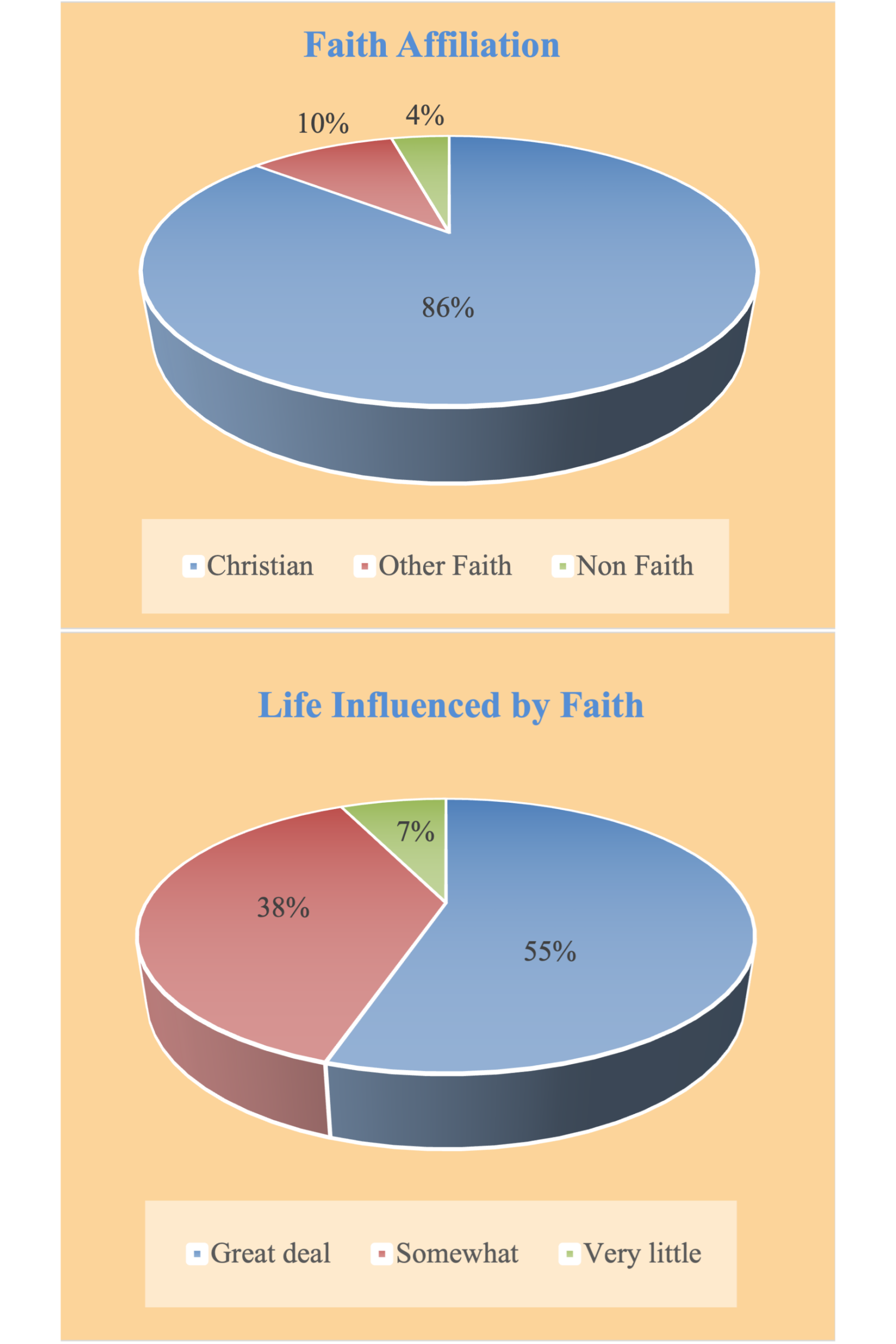
The Market Study Survey (2025) was conducted by Saurage Marketing Research, a Houston-based market research agency, on behalf of the Center for Christianity in Business. The survey collected responses from a final panel of 535 business executives who self-identified as faith-driven in their business practices. Of the 535 responses, 462 or 86.3% were self-identified as Christians. A snapshot of the geographic and demographic profile of the sample is provided in Figure A1, and the faith orientation of the respondents is summarized in Figure A2. The online questionnaire filled out by the respondents collected a variety of data on faith-orientation, leadership practices, views on work-life balance, moral and ethical dilemmas, evolving ethical and cultural issues impacting business, Christian work ethics, and faith integration beliefs.
Figure A1
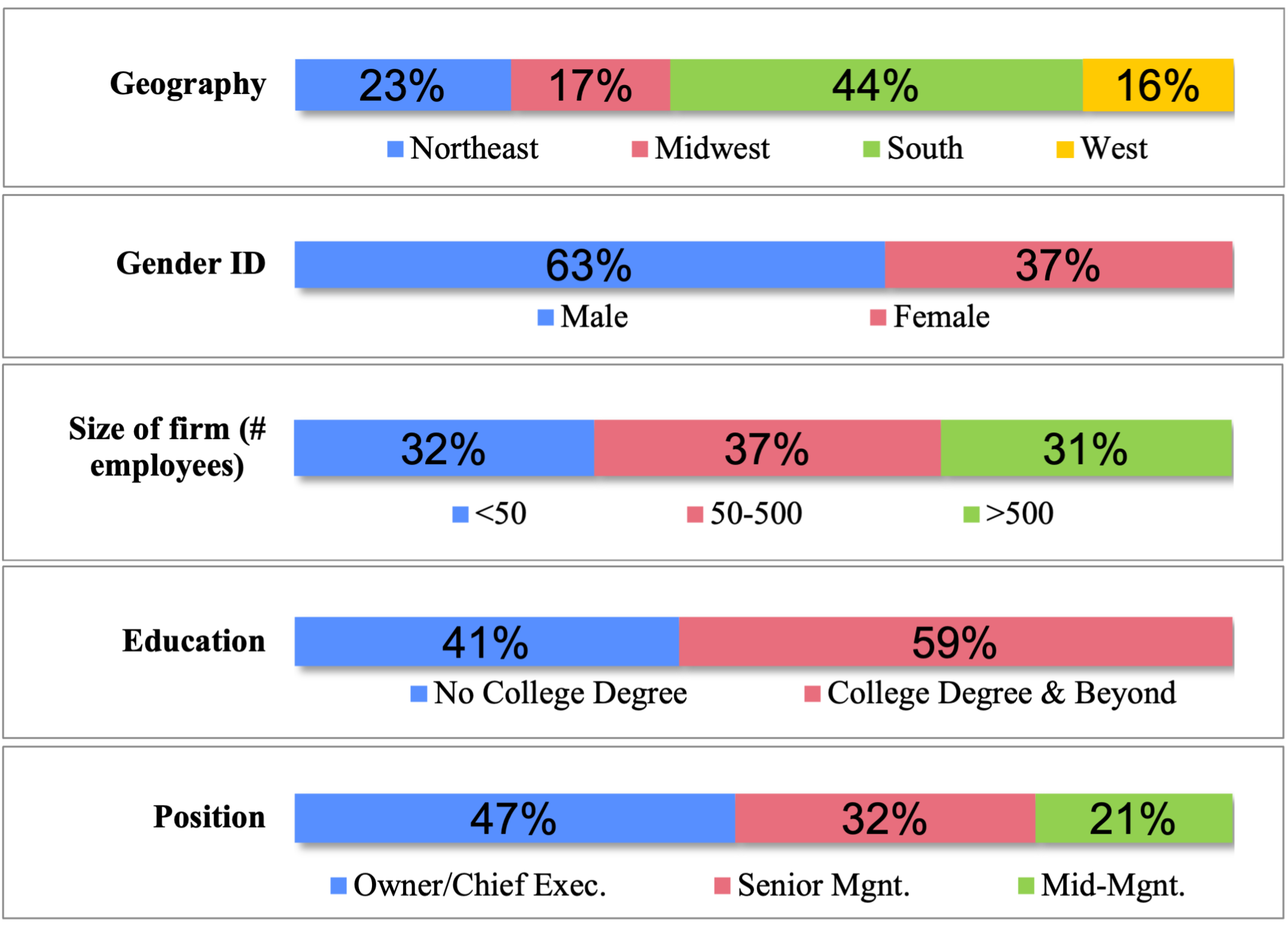
Figure A2
Notes
1 John Knapp, Why the Church Fails Business People: And What Can be Done About It? (Eerdmans, 2011)
2 Mark P. Phillips & Laura C. Phillips, “Shalom at Work: Bridging the Sunday-Monday Gap,” Journal of Biblical Integration in Business 24(1), 2021), 20.
3 The Barna Group, Christians at Work: Examining the Intersection of Calling and Career (Barna Group, 2018), 21.
4 Ibid., 48-49.
5 Gallup (Nov. 11, 2025), “Purpose Work Boosts Engagement, but Few Experience it.” https://news.gallup.com/poll/697403/purposeful-work-boosts-engagement-few-experience.aspx.
6 Yvonne Smith, “Three Myths of Good Hard Work,” Journal of Biblical Integration in Business 13(1) (2011), 90
7 D. Sherman & W. Hendricks, Your Work Matters to God (Colorado Springs, CO: NavPress, 1987).
8 M. Novak, Business as a Calling: Work and the Examined Life (New York: The Free Press, 1996).
9 R.P. Stevens, The Other Six Days: Vocation, Work, and Ministry in Biblical Perspective (Grand Rapids, MI: Eerdmans Publishing Co., 1999), and “The Marketplace: Mission Field or Mission?” Crux 37(3), 7-16.
10 Steve Rundle, “’Business as Mission’ Hybrids: A Review and Research Agenda” Journal of Biblical Integration in Business 15(1) (2012), 70.
11 Guy Morrill, You and Yours (New York: Fleming Revell Co., 1922), 89.
12Michael R. Baer, Business as Mission: The Power of Business in the Kingdom of God (Seattle, WA: YWAM Publishing, 2006), 12.
13Wayne Grudem, Business for the Glory of God: The Bible’s Teaching on the Moral Goodness of Business (Wheaton, IL: Crossway Books, 2003), 17.
14Darren Shearer, The Christ-Centered Company: 37 Biblical Business Habits to Build a Thriving Company that Honors Godand Blesses the World (Houston, TX: High Bridge Books, 2023), 1.
15 Ibid.
16 C. Neal Johnson, Business as Mission: A Comprehensive Guide to Theory and Practice (IVP Academic, 2009), 28.
17 Guy Morrill, You and Yours, 89.
18 Max Weber, The Protestant Work Ethics and the Spirit of Capitalism (trans. Talcott Parsons) (New York: Charles Scribner’s & Sons, 1930). Weber’s essay, “Die protestantische Ethik und der Geist des Kapitalismus,” was first published in the Archil für Sozialwissenschaft und Sozialpolitik (Vol. XX and XXI, for 1904-5. I).
19 Ibid., 117.
20 See, for example, Sascha O. Becker and Ludger Woessmann, ‘Was Weber Wrong? A Human Capital Theory of Protestant Economic History,” Quarterly Journal of Economics 124 (2) (2009): 531-96 (https://doi.org/10.1162/qjec.2009.124.2.531); Daron Acemoglu, Simon Johnson & James A. Robinson, “The Colonial Origins of Comparative Development: An Empirical Investigation,” American Economic Review 91 (5) (2001): 1369-1401 (https://doi.org/10.1257/aer.91.5.1369); and Tony Zhang, “Was Weber Really Wrong? A Comment on Some Recent Empirical Studies on Economic Growth,” Max Weber Studies 21(2) (July 2021), 203-212 (https://www-jstor-org.hc.idm.oclc.org/stable/10.15543/maxweberstudies.
21.2.203).
21 See, for example, Andrei Shleifer & Robert W. Vishny, “The Politics of Market Socialism,” The Journal of Economic Perspectives , 8(2) (Spring, 1994), 165-176.
22 Alexander Hill, Just Business (Downers Grove, IL.: IVP, 2008).
23 For example, a 2025 Gallup poll reports that 39% of all Americans view socialism with a positive attitude, while 66% of Democrats now view socialism favorably. At the same time, positive views of capitalism dropped to 54%. https://news.gallup.com/poll/694835/image-capitalism-slips.aspx.